Galilée
1564–1642 · First theory of beam strength; the scaling law (1638)
A Tuscan scientist, Galileo asked in 1638 the first question of the strength of materials: what load can a beam carry, and why large structures cannot be mere enlargements of small ones.
Biography
Born on 15 February 1564 in Pisa, Galileo Galilei studied medicine and then mathematics, which he taught in Pisa and Padua. His telescope observations and his defence of the Copernican system led to his condemnation by the Inquisition in 1633.
Under house arrest at Arcetri, near Florence, he wrote his “Discourses on Two New Sciences” there. He died at Arcetri on 8 January 1642.
What he invented or proved
In his “Discourses”, Galileo studied the failure of a cantilever beam and sought the load it could carry. His assumption about the distribution of forces in the section was wrong, but he stated the problem mathematically for the first time.
He also showed that strength grows with cross-section while weight grows with volume: a structure enlarged in proportion eventually collapses under its own weight.
His treatise
- Discourses and Mathematical Demonstrations Relating to Two New Sciences (Leiden, 1638).
What we owe Galilée
Self-weight grows faster than strength: Galileo’s scaling law explains why long spans demand ever lighter structures, from suspension bridges to prestressed box girders.
Sources
- G. Galilei, « Discorsi e dimostrazioni matematiche intorno a due nuove scienze » (Elzevier, 1638)
- S. P. Timoshenko, « History of Strength of Materials » (McGraw-Hill, 1953)
- Museo Galileo, Florence, biographie
Tester mes connaissances sur les grands bâtisseurs
See also
In our projects
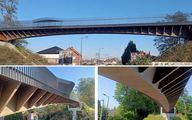
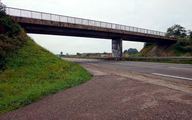
A few structures of the same type studied by THEOREMS.