Thomas Telford
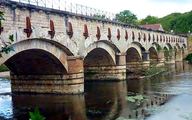
1757–1834 · Cast-iron Pontcysyllte Aqueduct (1805) and Menai Suspension Bridge (1826)
A shepherd’s son who trained as a stonemason, Thomas Telford covered Britain with roads, canals and bridges, and opened the era of great suspension bridges with the Menai Bridge.
Biography
Born on 9 August 1757 at Westerkirk, Dumfriesshire, Scotland, Thomas Telford lost his father, a shepherd, in the year of his birth. Apprenticed to a stonemason at fourteen, he worked in Edinburgh and then in London, on Somerset House, and taught himself architecture.
Appointed Surveyor of Public Works for Shropshire in 1787, he built his first bridges over the Severn there. Then came the Ellesmere Canal and its Pontcysyllte Aqueduct (1795–1805), the Caledonian Canal (1803–1822), the London to Holyhead road and its suspension bridges, and the Göta Canal in Sweden.
The first President of the Institution of Civil Engineers, from 1820 until his death, he died in London on 2 September 1834 and is buried in Westminster Abbey.
What he invented or proved
Telford dared to use cast iron where only stone had been used: at Pontcysyllte, a navigable canal crosses the Dee valley in a cast-iron trough more than 300 metres long, carried almost 38 metres high on slender masonry piers.
Over the Menai Strait, tall ships had to pass: he chose a suspension bridge hung from wrought-iron chains, with a 176-metre span, and had every bar tested one by one. He also codified road building on a foundation of hand-laid stones.
His works
- Pontcysyllte Aqueduct (1805), Wales, a UNESCO World Heritage Site since 2009.
- Craigellachie Bridge (1814), Scotland: a cast-iron arch of about 46 metres.
- Caledonian Canal (1822), coast to coast across Scotland.
- Menai Suspension Bridge (1826), 176-metre span, and Conwy Suspension Bridge (1826).
- Göta Canal (Sweden), completed in 1832 to his designs.
What we owe Thomas Telford
The cast iron and wrought iron of his structures cannot be welded: on the old metal bridges we assess, every repair relies on mechanical connections, after the material has been characterised. His masonry also reminds us that a well-drained structure lasts for centuries.
Sources
- Structurae, fiche « Thomas Telford »
- Institution of Civil Engineers, « Thomas Telford, first President of the ICE »
- Unesco, « Pontcysyllte Aqueduct and Canal » (2009)
- Encyclopædia Britannica, « Thomas Telford »
Tester mes connaissances sur les grands bâtisseurs
See also
In our projects
A few structures of the same type studied by THEOREMS.