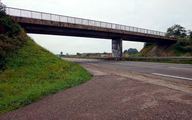
Heinrich Gerber
1832–1912 · Gerber beam (1866): a continuous beam made statically determinate by hinges
A Bavarian engineer, Heinrich Gerber invented the hinged beam that bears his name, making long continuous girders insensitive to support settlement.
Biography
Born on 18 November 1832 in Hof, Bavaria, Heinrich Gerber studied at the Munich Polytechnic School. He worked on the Großhesselohe bridge over the Isar, then joined the steel construction firm that would become MAN, where he led bridge construction.
He patented his hinged beam in 1866 and the following year built the first bridge of this type, over the Main at Haßfurt. He went on to build many bridges in Germany. He died in Munich on 3 January 1912.
His system was applied worldwide, up to the Forth Bridge.
What he invented or proved
The Gerber beam is a continuous beam in which hinges are placed at the right points, near where the moment vanishes: it becomes statically determinate, is simple to analyse and does not suffer from support settlement, while retaining the economy of continuity.
The principle, with cantilevers carrying a suspended span, is that of the great cantilever bridges.
His works
- Großhesselohe bridge (1857), over the Isar, near Munich.
- Gerber beam (1866 patent).
- Haßfurt bridge (1867), over the Main: the first Gerber beam bridge.
What we owe Heinrich Gerber
The hinges of Gerber beams, in steel as in concrete, are sensitive points: corrosion, cracking of halving joints, seized bearings. Inspecting and recalculating them is part of our routine assessments.
Sources
- Structurae, fiche « Heinrich Gerber »
- Deutsche Biographie, « Gerber, Heinrich »
- K.-E. Kurrer, « The History of the Theory of Structures » (Ernst & Sohn, 2008)
- MAN, histoire de l’usine de Gustavsburg
Tester mes connaissances sur les grands bâtisseurs
See also
In our projects
A few structures of the same type studied by THEOREMS.