Jacques Heyman
1925– · Limit analysis of masonry: “The Stone Skeleton” (1966)
A Cambridge professor, Jacques Heyman applied plastic theory to masonry and showed that the safety of a vault or a cathedral depends above all on its geometry.
Biography
Born on 8 March 1925, Jacques Heyman went up to the University of Cambridge at sixteen, in 1941, to read mathematics, then moved to engineering. He worked in John Baker’s team on the plastic design of steel frames.
A professor from 1971 to 1992 and head of the engineering department from 1983 to 1992, he advised on the restoration of many English cathedrals. He celebrated his hundredth birthday in 2025.
What he invented or proved
In “The Stone Skeleton”, in 1966, Heyman set three assumptions for masonry: unlimited compressive strength, zero tensile strength, no sliding. The safe theorem of plastic theory then applies: if a line of thrust can be found within the masonry, the structure is stable.
He thus explained the cracks in old vaults, which do not threaten stability as long as the geometry is preserved.
His work and books
- The Stone Skeleton (1966; book in 1995).
- The Masonry Arch (1982).
- Consulting engineer to the cathedrals of Ely, St Albans, Lichfield and Worcester.
What we owe Jacques Heyman
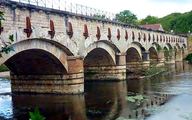
His work underpins the modern assessment of masonry bridges: limit analysis of arches, interpretation of cracks, search for an admissible line of thrust before any strengthening.
Sources
- J. Heyman, « The stone skeleton », International Journal of Solids and Structures (1966)
- Royal Academy of Engineering, « Sir Frank Whittle Medal : Professor Jacques Heyman » (2022)
- University of Cambridge, Department of Engineering, « Professor Jacques Heyman »
- Peterhouse, Cambridge, « Emeritus Fellow celebrates 100th birthday » (2025)
Tester mes connaissances sur les grands bâtisseurs
See also
In our projects
A few structures of the same type studied by THEOREMS.